
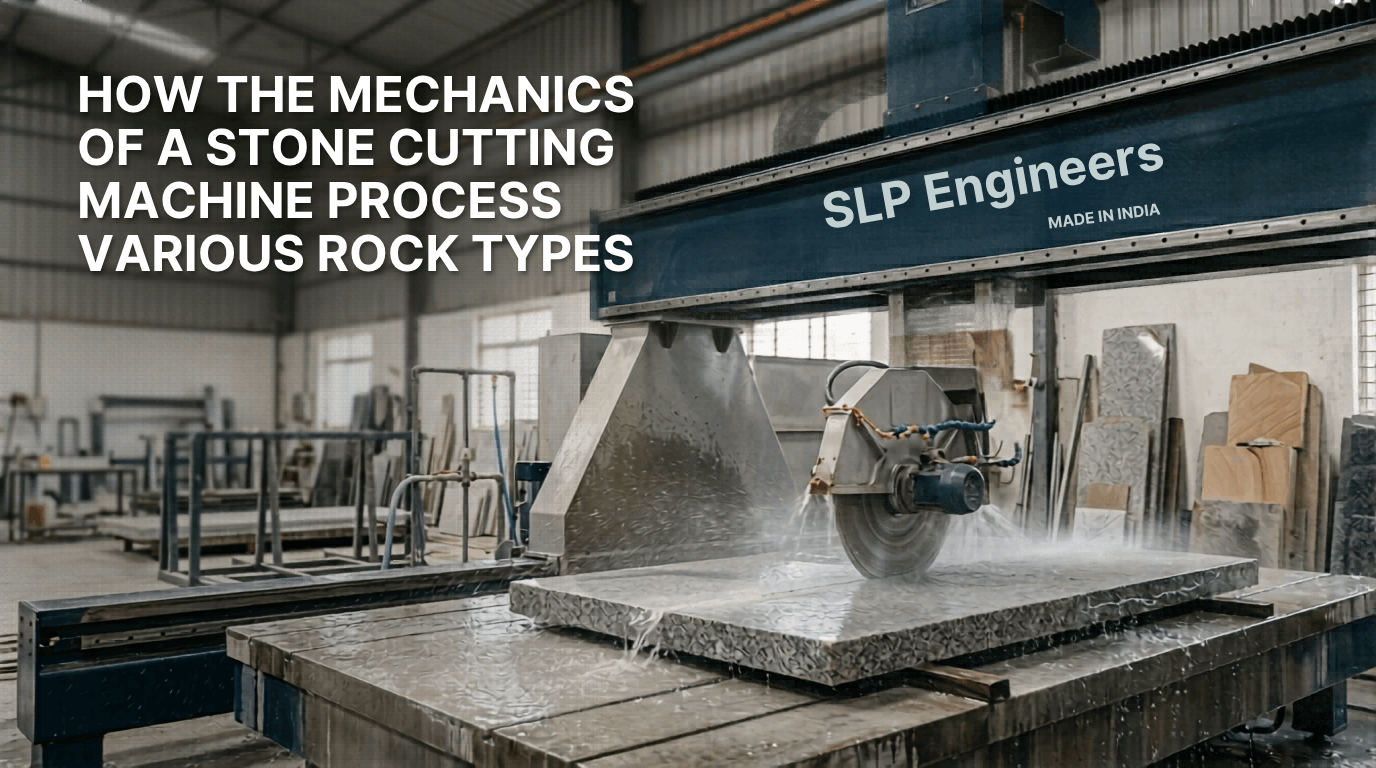
When you walk into a stone processing unit, the first thing that hits you is the sound of constant water spray and the low hum of heavy motors. Most people think a Stone Cutting Machine just pushes a blade through a rock like a knife through butter, but the reality is much more about controlled friction. These units use industrial diamonds embedded into the edges of circular blades or long wires. Instead of a sharp edge slicing the material, these diamonds actually grind away the stone bit by bit at a very high speed.
Water plays a massive role here because without it, the heat generated would melt the metal holding the diamonds in place within seconds. The liquid keeps the blade cool and flushes away the fine slurry that forms during the process. In many setups, the stone stays still on a heavy table while the overhead bridge moves the blade along a set path. Other times, for much larger tasks, the entire block might move on a rail system toward a stationary blade.
Understanding the Mechanics of Different Equipment
Inside the assembly line, different tasks require specific mechanical movements to ensure the material is handled correctly.
- Block Processing: A Stone Block Cutting Machine often handles the initial stage where raw boulders from the quarry get squared up. These are massive pieces of equipment because they have to support the weight of several tons without vibrating. If the frame shakes even a little, the cut becomes uneven, which wastes expensive material.
- Power Consistency: Many operators notice that the motor power needs to stay consistent to avoid stalling mid-cut. Compared to smaller tools, these industrial versions use heavy-duty hydraulic systems to manage the pressure.
- Maintenance Needs: Over time, the bearings and rails require grease because the fine stone dust can act like sandpaper, wearing down the metal parts. It is a constant battle against friction and debris to keep the accuracy within a few millimetres.
Working with Specific Stone Varieties
Not all rocks behave the same way under a diamond blade. A Marble Cutting Machine usually runs at a slightly different speed than one meant for harder materials. Marble is softer and more prone to chipping if the blade is too aggressive. Workers usually watch the edges closely to ensure the polish remains intact during the sizing process. It feels different to cut marble compared to quartz or sandstone because the density changes how the machine sounds.
On the other hand, a Granite Cutting Machine has to be much tougher. Granite contains high amounts of silica and feldspar, making it one of the hardest natural stones used in building. The blade has to work harder, and the diamond segments need to be bonded with a stronger metal matrix. If you try to use a soft-bond blade on granite, it wears out almost immediately. Operators often check the cooling water flow more frequently when dealing with dark granites because they hold heat longer than lighter stones.
Specialized Applications for Architectural Needs
Sometimes the requirement is not just for flat slabs but for specific structural shapes. This is where a Granite Door Frame Cutting Machine comes into play. Instead of just making straight horizontal or vertical passes, these units are set up to create the grooves and notches needed for joinery. It involves more precision because these pieces must fit together perfectly at the construction site. Many builders prefer these machine-finished frames rather than manual chiselling because the lines stay crisp and straight over long distances.
Similarly, when the goal is producing flooring, a Granite Tile Cutting Machine is used to ensure every piece is exactly the same size. In a real-world scenario, even a one-millimetre difference in tile thickness can make a floor feel uneven underfoot. The machines used by SLP Engineers are often calibrated daily to prevent this kind of drift. It is more about the stability of the guide rails than the sharpness of the blade itself.
Capacity for Large Scale Production
For the primary stages of production, the focus is on volume and raw power. A Stone Cutting Machine is designed to take a rough piece of earth and turn it into manageable sections. This process can take hours depending on the thickness of the block. You usually see these machines running in shifts because stopping a cut halfway through can leave a permanent mark on the stone surface.
In many Indian factories, the efficiency of these machines determines the overall output of the plant. SLP Engineers provide equipment that handles these heavy vibrations daily. When a factory deals with high-density materials, the strain on the electrical components is significant. Rather than just looking at the motor, experienced technicians look at the cooling system and the tension of the drive belts to ensure the machine does not overheat during a long run.
Final Touches and Precision Tasks
After the big blocks are broken down, the focus shifts to the final dimensions. Using a Stone Cutting Machine for the finishing stages requires a lighter touch. This is where the accuracy of the sensors and the smoothness of the table movement matter most. If the table jerks, the stone might crack. Most breakages happen right at the end of a cut when the weight of the stone piece starts to pull away from the main body.
The Stone Cutting Machine Price often reflects the level of automation and the thickness of the steel used in the frame. Cheaper machines might look the same, but they often use thinner metal that flexes under pressure. Professional workshops usually invest in heavier frames to ensure that a Granite Tile Cutting Machine stays true over years of use. SLP Engineers focus on building these robust structures that withstand the acidic nature of the slurry and the constant humidity of a stone shed.
Why the Material Determines the Tool
Usually, a worker will select a specific blade based on the stone’s hardness. You wouldn’t use the same setup for a soft limestone that you would for a hard volcanic rock. Many people forget that the speed of the blade needs to be adjusted; spinning too fast can actually glaze the diamonds, making them smooth and useless. It is a balance between the downward pressure and the rotational speed.In the case of architectural details, like the ones made by a Granite Door Frame Cutting Machine, the setup time is often longer than the cutting time. Measuring the angles and ensuring the stone is clamped down tightly prevents ruined pieces. Compared to manual work, these machines save a huge amount of time and reduce physical strain on the labourers. SLP Engineers understands that in a busy production environment, the reliability of the mechanical parts is what keeps the business profitable. Every Stone Cutting Machine in a workshop serves a purpose, whether it is for bulk processing or fine detail work.
Contact Us
Business Name – SLP Engineers
Explore and Buy Our Stone Machines – https://slpengineers.com/
Meet us at… G1, 118 Road No. 3C, BIA Kaladwas, Eklingpura, Udaipur, Rajasthan, India – 313003
Order Today – +91 96603 60972
Write Us – slpengineers01@gmail.com
